Armoured Land Rovers: Shorland, Hotspur, Simba and Tangi
- Years
- 1965 onwards
- Engine
- 2.25-litre four (early Shorland) to 3.5-litre V8 (Mk 4 on)
- Drive
- 4x4
- Origin
- Belfast, Northern Ireland
No Land Rovers worked harder than the armoured ones that policed Northern Ireland. The lineage runs from a turreted patrol car conceived in 1961 to vehicles that were still on Belfast streets under the Police Service of Northern Ireland decades later, and most of it was designed and built within a few miles of the city.
The Shorland
The Shorland Armoured Patrol Car began with a design meeting in November 1961, drawn up by Frederick Butler specifically for the Royal Ulster Constabulary and built by Short Brothers and Harland in Belfast. Underneath sat the 109-inch Series IIA chassis to military heavy-duty specification, clad in mild-steel armour proof against small arms and fragmentation. On top went a manually traversed turret closely resembling that of the Ferret scout car, mounting a .30 Browning machine gun, with a crew of three inside.
The first batch of ten was completed in November 1965 and delivered to the RUC in May 1966. In 1970, following the escalation of the Troubles, the RUC’s Shorlands were transferred to the newly formed Ulster Defence Regiment. Development continued for the export market through successive marks, and small numbers were still being used on Northern Ireland’s streets as late as 1998.
| Version | Introduced | Notes |
|---|---|---|
| Mk 1–Mk 2 | 1965 on | Series IIA 109 in chassis, four-cylinder petrol |
| Mk 3 | 1972 | Uprated engine, output rising towards 91 bhp across the early marks |
| Mk 4 | 1980 | 3.5-litre Rover V8 |
| Series 5 (S51–S55) | 1980s | Defender 110 chassis, multiple role variants |
Export success outlasted the home story. Shorlands went to more than 30 countries, including 100 to Turkey, 72 to Iraq and 38 to Portugal.
Hotspur, Simba and Tangi
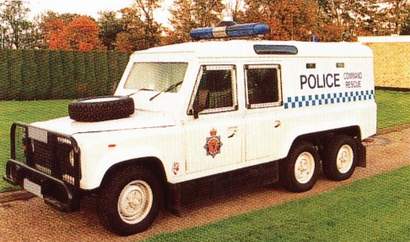
The RUC’s day-to-day armoured fleet was a different animal from the turreted Shorland: armoured personnel carriers on ordinary Land Rover chassis, built to move officers through hostile streets rather than to fight. Hotspur-armoured Land Rovers carried much of that burden first. When they began wearing out, the force developed the Simba in the early 1980s, a purpose-built and more sophisticated design that proved slow to produce, which left a gap the fleet could not afford.
The answer was the Tangi, named from the Swahili word for tank. It was designed and built in-house by the RUC’s own vehicle engineering team at Seapark, outside Belfast, initially by transferring armour kits from retired Hotspurs onto new civilian Defender 110 chassis. When the stock of donor kits ran out, the Seapark workshops fabricated new ones. A police force manufacturing its own armoured vehicles is a rarity anywhere in the world, and the Tangi became the visual shorthand for policing in Northern Ireland. Simbas can be told apart by their more angular rear bodies.
After the RUC
The PSNI inherited the Tangi fleet when it replaced the RUC in 2001 and kept the type in service for years afterwards. The vehicles have since been phased out in favour of the OVIK Pangolin public-order Land Rovers and Penman-built equivalents, closing a production story that ran through Belfast for half a century. The wider family of British service types is indexed on the military Land Rovers pages.
Survivors
Shorlands turn up in museums and private collections, with the Ulster Transport Museum holding an example, and export vehicles occasionally resurface abroad. Tangis are harder to find in civilian hands, since armoured police vehicles are usually decommissioned rather than sold, but preserved examples exist and the type is well documented by modellers and vehicle historians.