Emergency-service Land Rovers
- Years
- 1950s onwards
- Drive
- 4x4 and 6x4/6x6
- Origin
- United Kingdom
Land Rovers on call
Fire brigades, ambulance services and police forces have run Land Rovers almost from the beginning, and the emergency fleet produced some of the strangest machinery ever to wear the badge: six-wheeled fire engines, coach-built field ambulances and armoured patrol vehicles fabricated in a police workshop. This profile follows the three strands in turn.
Fire
Specialist converters did most of the fire work, and Carmichael of Worcester became the best known of them. The most famous product of that partnership is the TACR2, a rapid-intervention airfield crash-rescue vehicle introduced in the early 1970s for the RAF and the Royal Navy. Built by Carmichael and by Gloster Saro, it used the Carmichael Commando chassis: a Range Rover extended 775 mm at the rear onto a third axle, usually driven as a 6x4, with a number converted to full six-wheel drive. Speed was the whole point. The TACR2’s job was to reach a burning aircraft ahead of the heavy foam tenders, and the type earned a reputation for outrunning the police patrol cars of its day.
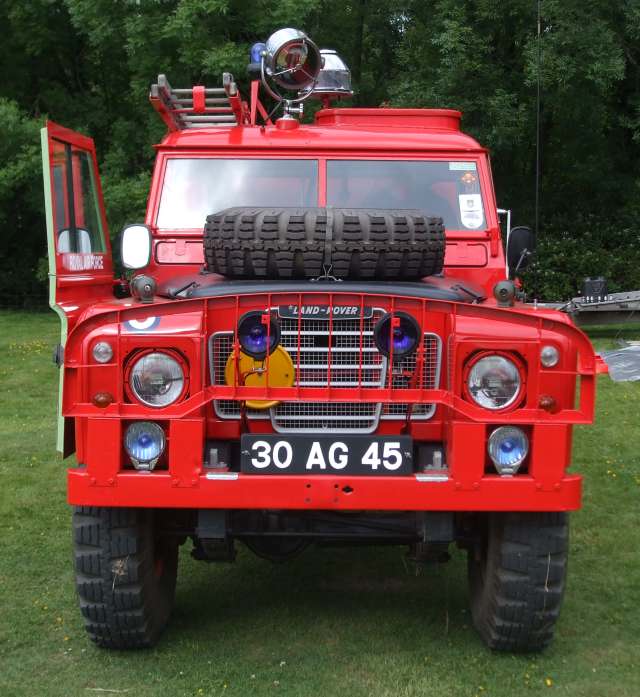
The TACR2 had a predecessor with a plainer recipe. The TACR1 — the initials stand for Truck, Airfield Crash Rescue — was built on the standard leaf-sprung 109-inch chassis, carrying a light foam and dry-powder attack directly to the crash site while the heavy tenders followed. Preserved examples still wear their military registrations and Royal Air Force liveries on the show circuit, instantly recognisable by the beacon bar, ladder rack and roof-mounted floodlight over an otherwise ordinary Series body.
Ambulance
Military ambulance work stretches from the Series era to the Defender, with Marshall of Cambridge the dominant coachbuilder throughout. Ambulances to Ministry of Defence specification were built on the Series II, IIa and III 109-inch chassis from the late 1950s into the early 1980s, around 2,000 in all. The 101 Forward Control gained an ambulance body too, with a twist: every 101-based ambulance was completed during 1981 and 1982 using factory-remanufactured vehicles that had originally been built in 1976. Bodied 127-inch chassis followed, carrying coachwork by Marshall and by Locomotors.
The largest modern order came on 18 January 1996, when the Ministry of Defence ordered 800 field ambulances with Marshall bodywork on the Defender 130 XD chassis, part of a contract that also covered 8,000 XD90 and XD110 utility vehicles. Known as the Pulse, the ambulance entered service from April 1997 and was dimensioned for air mobility at 5,194 mm long and 2,136 mm wide, sized to load into a Hercules transport aircraft.
Police
The hardest-worked police Land Rovers in the United Kingdom served in Northern Ireland. The Tangi was designed and built not by an outside contractor but by the Royal Ulster Constabulary’s own vehicle engineering team at Seapark, outside Belfast. Armour kits recovered from retired Hotspur vehicles were fitted to new Defender 110 chassis, and once the donor kits ran out the workshops fabricated fresh armour themselves. Tangis served with the RUC and then the Police Service of Northern Ireland, and have since been phased out in favour of the purpose-built OVIK Pangolin.
| Role | Notable type | Builder |
|---|---|---|
| Airfield crash rescue | TACR2 (Range Rover 6x4/6x6) | Carmichael; Gloster Saro |
| Field ambulance | Pulse (Defender 130 XD) | Marshall |
| Armoured patrol | Tangi (Defender 110) | RUC workshops, Seapark |
Civilian and military threads cross constantly here. The Pulse is a battlefield vehicle, the TACR2 guarded service airfields, and the Tangi policed British streets under armour, so the emergency fleet belongs as much to the service story told in the guide to military Land Rovers as it does to any county fire station or ambulance depot.
Frequently asked questions
What was the TACR2?
A rapid-intervention airfield crash-rescue vehicle built by Carmichael and Gloster Saro from the early 1970s on the Carmichael Commando chassis: a Range Rover extended onto a third axle, usually as a 6x4, some converted to full six-wheel drive.
Who built military Land Rover ambulances?
Marshall of Cambridge was the dominant coachbuilder, from roughly 2,000 Series-based ambulances through to the Pulse on the Defender 130 XD chassis, 800 of which were ordered in January 1996.
What is a Tangi Land Rover?
An armoured patrol vehicle designed and built by the Royal Ulster Constabulary’s own vehicle engineering team at Seapark on new Defender 110 chassis, later phased out in favour of the OVIK Pangolin.
Why did airfields use Land Rover-based fire engines?
Speed. A rapid-intervention vehicle like the TACR2 could reach a burning aircraft well ahead of the heavy foam tenders, and the first minutes decide the outcome of an aircraft fire.