Land Rover Lightweight: The Air-Portable Half-Ton
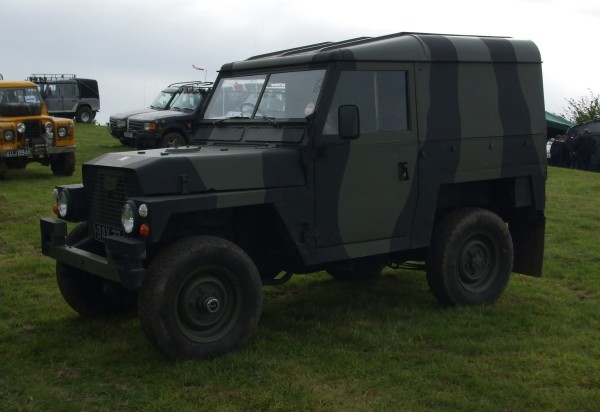
- Years
- 1968–c. 1984
- Engine
- 2.25-litre four-cylinder petrol or diesel
- Drive
- 4x4
- Origin
- Land Rover, Solihull
The Land Rover Lightweight is the vehicle whose name tells a small lie. Fully assembled, the Air-Portable half-ton weighed more than the standard 88-inch Series IIA it was derived from. The name only makes sense once the panels start coming off.
Why the Army wanted it
In the early 1960s the Royal Marines and the British Army needed a utility vehicle that could travel by air. The Westland Wessex helicopter could lift 2,500 lb (1,134 kg) slung beneath it, and that figure became the target. The vehicle also had to be narrow enough to load two-abreast into the Argosy transport aircraft, which meant trimming around four inches from the width of a standard Land Rover.
Solihull’s answer, developed from 1965, was not a smaller Land Rover but a demountable one. The hood, windscreen, body sides, bumpers and spare wheel could be stripped quickly in the field and flown on as a separate package, bringing the hull down to 2,808 lb (1,274 kg). Fully equipped, the vehicle came to 3,329 lb (1,510 kg), over the original specification and heavier than the civilian 88 thanks to all the brackets and fasteners the demountable design required.
Development and production
The first production vehicles were completed on 11 November 1968, built on the Series IIA base with the 2,286 cc four-cylinder engine in 70 bhp petrol or 62 bhp diesel form, on the familiar 88-inch wheelbase. The Series IIA Lightweight ran until 1972, with 2,989 built according to figures compiled by the Military Lightweight Club. The Series III version took over from 1972, and the club puts its production at 12,334 vehicles up to 1980, with the model continuing into the mid-1980s.
Total production is genuinely disputed. Enthusiast-club tallies arrive at around 18,000 Lightweights across both series, while other published references quote 37,897. The gap is too wide to split, so both figures deserve to be on record until someone reconciles the ledgers.
| Version | Years | Recorded production |
|---|---|---|
| Series IIA Lightweight | 1968–1972 | 2,989 |
| Series III Lightweight | 1972–c. 1984 | 12,334 to 1980; totals beyond that disputed |
Service life
By the time the Lightweight entered service, more powerful helicopters were already arriving, and the elaborate strip-down routine was rarely used in practice. What the forces got instead was a tough, slightly narrow utility vehicle that served across the British Army and RAF for the better part of two decades, one of the mainstays covered on the military Land Rovers reference pages.
Export sales reached more than 20 countries. The club’s records list Belgium, Brunei, Guyana, the Netherlands, Hong Kong, Indonesia, Jamaica, Libya, Saudi Arabia and Sudan among the customers, and the Dutch military took its Lightweights predominantly as left-hand-drive diesels.
Survivors
Demobbed Lightweights passed into private hands in large numbers as the fleets were run down, and the type remains one of the most attainable ex-military Land Rovers. Mechanical parts are shared with civilian Series vehicles, which keeps restoration practical, while the military-specific panels and fittings have their own following. The Military Lightweight Club maintains registers and documentation for the type, and an unrestored, verifiably original example now attracts more interest than a shiny one.
Judging one is mostly a matter of arithmetic and honesty. The narrow body and the demountable panels — and the extra brackets and fasteners that make the whole design possible — are what separate a Lightweight from an ordinary 88 wearing green paint, and they are also the parts most often missing after a civilian repaint or a hard service life. A vehicle with its removable top, sides and screen all present and matching is a better starting point than a prettier truck without them, because the mechanical side can be put right from ordinary Series parts while the airportable fittings cannot.
Frequently asked questions
Why is it called the Lightweight if it weighs more than a standard 88?
The name refers to the stripped state. With hood, windscreen, body sides, bumpers and spare wheel removed for air transport the hull came down to 2,808 lb — light enough for a Wessex helicopter’s 2,500 lb slung-load limit to be met by the follow-on package arrangement the design was built around.
How many Lightweights were built?
It is genuinely disputed. Club tallies arrive at around 18,000 across the Series IIA and III versions, while other published references quote 37,897.
Which countries used the Lightweight?
The British Army and RAF at home, with exports to more than 20 countries including Belgium, the Netherlands, Brunei, Jamaica and Saudi Arabia. The Dutch military took theirs mainly as left-hand-drive diesels.
Is a Lightweight a good first ex-military Land Rover?
One of the most attainable. Demobbed examples passed into private hands in large numbers and the mechanical parts are shared with civilian Series vehicles, which keeps restoration practical.