Amphibious Land Rovers: APGP, OTAL and the Floating Ninety
- Years
- 1963 onwards
- Drive
- 4x4
- Origin
- United Kingdom
Land Rover kept trying to make its vehicles swim, and the services kept deciding they would rather not. The amphibious experiments span from a stackable 1963 troop-trials vehicle to a floating show car and, eventually, aftermarket conversions that actually reached customers. None of the military attempts entered service. All of them are worth knowing.
APGP: the stackable swimmer (1963)
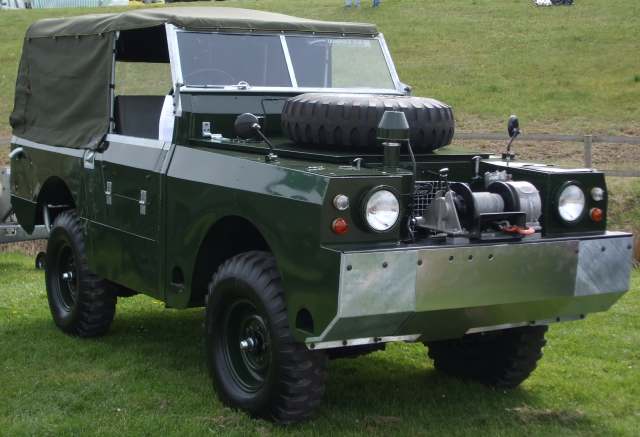
The Air Portable General Purpose Land Rover, built around a heavy-duty military-specification 109 with 24-volt electrics, was designed to come ashore in sea landings and fly forward with airborne forces. The body was waterproofed, and flat air bags fitted to the front and sides were inflated from the vehicle’s own exhaust to provide buoyancy. A small propeller mounted on the rear propshaft pushed it through the water while the front wheels steered.
Its cleverest trick had nothing to do with swimming: the bodywork was shaped so that APGPs could be stacked two high inside a transport aircraft. A trials batch was built in 1963–64, with published accounts putting the number at about 26 vehicles and others claiming as many as 50. The type went through troop trials in 1964 and stopped there. Preparing one for the water took too long to be tactically useful, and a vehicle kept afloat by inflatable bags is an easy thing to sink.
OTAL: the One Ton that swam (1965)
The One Ton Amphibious Land Rover of 1965 took a different approach. Built as a prototype for the Australian Army on the running gear of what became the 109 One Ton, with the 2.6-litre six-cylinder petrol engine, it abandoned inflatable floats in favour of aluminium watertight compartments filled with expanded foam. In the water it had no propeller at all. Propulsion and steering came from the rotating tyres, which made it slow but mechanically simple.
OTAL was tested in Britain, including slipway trials at Packington in 1966, then shipped to Australia for evaluation. The Australians passed, and the vehicle came home. It is usually described as a one-off, though some older accounts refer to two prototypes. It spent the early 1970s at Eastnor Castle, passed to the British Motor Industry Heritage Trust at Gaydon by 1983, and was restored in 2008. It survives today in the Dunsfold Collection.
| Project | Year | Flotation | Outcome |
|---|---|---|---|
| APGP | 1963–64 | Exhaust-inflated air bags | Troop trials only, not adopted |
| OTAL | 1965 | Foam-filled aluminium compartments | Rejected after Australian trials; survives at Dunsfold |
| Floating Ninety | late 1980s | Sealed cabin and inflatable pontoons | Promotional vehicle, survives |
The floating Ninety
Two decades later the idea returned as marketing. Land Rover’s Special Vehicle Operations department converted a Ninety, itself built to mark the company’s 40th anniversary, into an amphibian for the firm’s sponsorship of Cowes Week, which ran from 1987 to 1990. Rather than reshaping the chassis into a hull, the engineers sealed the cabin with fibreglass and fitted inflatable pontoons, borrowing directly from the 1960s military prototypes. Sources date the conversion to 1988 or 1989 depending on which account you read. The vehicle survives and has been demonstrated on open water since.
SeaRoader and the private builders
The only amphibious Land Rovers ever really offered to the public came from outside Solihull. English engineer Mike Ryan, who has been building amphibious vehicles since the 1980s, chose a Land Rover as the basis of his first production SeaRoader amphibian, driven on land by its diesel engine and pushed through the water by dedicated marine propulsion. Ryan’s wider portfolio of conversions has featured regularly in the British motoring press, and his Land Rover work stands as proof that the swimming 4x4 was always achievable. It just never found a military customer.