Discovery specials and oddities
- Years
- 1989 onwards
- Engine
- 200 Tdi / 300 Tdi (Camel Trophy vehicles)
- Drive
- 4x4
- Origin
- Solihull, England
The odd corners of the Discovery story
Model histories of the Discovery are easy to find, and this profile is not another one. It covers something narrower: the Discoverys that did unusual work, from jungle expeditions to motorway hard shoulders, together with the design quirks that nearly made production and the odd milestone the model picked up along the way.
Project Jay and the Conran interior
The Discovery was developed under the code-name Project Jay and unveiled at the Frankfurt Motor Show in 1989, going on sale in Britain that October, initially as a three-door. The interior was the strange part. Land Rover handed the job to the Conran Design Group with instructions to ignore existing car-interior convention, and the resulting cabin won a British Design Award in 1989. The mock-ups, built inside a Range Rover bodyshell at Conran’s workshops, included ideas that never reached the showroom, among them a sunglasses holder set into the centre of the steering wheel.
Camel Trophy, 1990 to 1997
The Discovery became the Camel Trophy team vehicle in 1990, taking over for the Siberia event, which ran from Bratsk through the taiga to Lake Baikal and on to Irkutsk. Those first team cars were three-door 200 Tdis in the event’s Sandglow yellow. Discoverys then carried every Camel Trophy up to Mongolia in 1997, by which time the teams were running five-door 300 Tdi vehicles. Mongolia was the model’s final outing; the 1998 event switched to the Freelander.
| Year | Camel Trophy event |
|---|---|
| 1990 | Siberia, USSR |
| 1991 | Tanzania–Burundi |
| 1992 | Guyana |
| 1993 | Sabah, Malaysia |
| 1994 | Argentina–Paraguay–Chile |
| 1995 | Mundo Maya, Central America |
| 1996 | Kalimantan, Indonesia |
| 1997 | Mongolia |
Genuine team vehicles survive in enthusiast hands, and they trade on that history; a Romanian-team car from the 1997 Mongolia event has been offered for sale as a documented veteran.
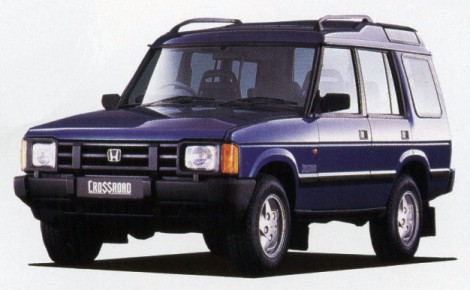
The Discovery that wore a Honda badge
The strangest Discovery of all carried no Land Rover badging. Between 1993 and 1998 the Discovery Series I was sold in Japan as the Honda Crossroad, a straight rebadge born of the long-standing alliance between Honda and the Rover Group. Japanese buyers collected their British-built 4x4 from a Honda showroom, V8 and all, and the arrangement only ended once BMW’s purchase of Rover dissolved the partnership. Survivors occasionally reach Britain as grey imports, where a Honda-badged Discovery reliably confuses everyone at the filling station.
Motorway patrol
The Discovery’s least glamorous special duty may be its most visible. Highways Agency traffic officers began working alongside the police in April 2004, patrolling the M5, M6 and M42 in the West Midlands, and the national roll-out was completed in July 2006. The Discovery has been a mainstay of the patrol fleet ever since. In 2019 Land Rover handed over the first of 70 new Discoverys to Highways England, and as of 2021 the service ran roughly 200 vehicles, mostly Discoverys and Mitsubishi Shoguns, each carrying a two-officer team and around 625 kg of equipment. That kit list runs from traffic cones and collapsible barriers to an ultra-strong towing strop, used to drag a stranded lorry clear of a live carriageway, which is exactly the sort of job the Discovery’s towing capacity was specified for. Fire, ambulance and police builds across the marque’s whole range are covered in the profile of emergency-service Land Rovers.
A production landmark
One more oddity of timing: when Land Rover completed its four-millionth vehicle in May 2007, the milestone machine was a Discovery 3. For a model line conceived as a cheaper companion to the Range Rover, ending up as the marque’s landmark vehicle was a quiet vindication.
Frequently asked questions
What was the Honda Crossroad?
A rebadged Land Rover Discovery Series I sold in Japan between 1993 and 1998 through Honda dealers, a product of the Honda–Rover Group alliance that ended after BMW bought Rover.
Why was the original Discovery interior unusual?
Land Rover commissioned the Conran Design Group to design it with instructions to ignore existing car-interior convention; the result won a British Design Award in 1989.
Which Camel Trophy events used the Discovery?
Every event from Siberia in 1990 through Mongolia in 1997, first as three-door 200 Tdis in Sandglow yellow, later as five-door 300 Tdis. The 1998 event switched to the Freelander.
Do motorway traffic officers still use Discoverys?
Yes. Discoverys have been a mainstay of the patrol fleet since the service began in 2004; Land Rover handed over the first of 70 new Discoverys in 2019, and as of 2021 the fleet ran to roughly 200 vehicles.