Land Rover Forward Controls: Series IIA, IIB and the 101
- Years
- 1962–1978
- Engine
- 2.25 four / 2.6 six / 3.5-litre V8 (101)
- Drive
- 4x4
- Built
- c. 3,190 IIA; c. 2,300 IIB; 2,669 101
- Origin
- Land Rover, Solihull
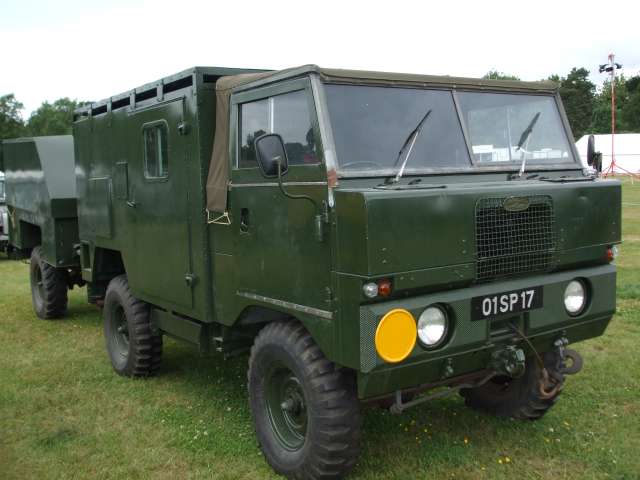
Sit the driver on top of the engine instead of behind it and a 109-inch Land Rover suddenly has room for a proper truck bed. That is the whole idea of the Forward Control, and Solihull pursued it through three distinct generations between 1962 and 1978, ending with the V8-powered 101 built for the British Army.
Series IIA Forward Control (1962)
The first production Forward Control went on sale in 1962, built on a modified 109-inch chassis with the 2.25-litre engine tucked beneath a cab-over body. The layout traded refinement for load space, and the trade was steep. With roughly 77 bhp hauling a vehicle designed around a 30 cwt class payload, the IIA FC was slow, and contemporary users found the steering vague and the unladen front end nervous under braking. Around 3,190 were built before the design was reworked.
Series IIB (1966)
The Series IIB of September 1966 addressed the worst of it. The wheelbase grew to 110 inches, heavier ENV axles went underneath with a wider track, and the 2.6-litre six-cylinder petrol engine, adapted from the unit used in Rover’s P4 and P5 saloons, joined the options list alongside the four-cylinder petrol and diesel. Production ran until the early 1970s, with around 2,300 built. Civilian FCs found work as fire appliances, tippers and mobile workshops, but the numbers never justified the model line, and it made way for a military project with a very different budget.
The 101 Forward Control (One Tonne)
The 101 answered a British Army requirement for a gun tractor able to tow the 105 mm Light Gun while carrying a tonne of ammunition and crew equipment in the back. Land Rover gave it the Range Rover’s 3.5-litre V8 and LT95 gearbox, a 101-inch wheelbase that produced its designation, and an almost perfectly cuboid body, since a vehicle with no bonnet wastes no space inside a transport aircraft. It was built in left- and right-hand drive with 12-volt or 24-volt electrics, and some vehicles carried a PTO-driven Nokken capstan winch that could work to the front or the rear. The design also provided for driving a powered trailer, extending the drivetrain beyond the vehicle itself.
Production totalled 2,669 vehicles. Sources differ on the span: the commonly cited series-production window is 1975 to 1978, while some references date the run from 1972, folding in the pre-production batches. Variants included the general-service gun tractor, ambulances bodied by Marshall of Cambridge, radio trucks, and around 21 examples of the electronic-warfare body known as Vampire. Beyond the British Army and RAF Regiment, Australia took 50 for towing Rapier missile systems.
| Generation | Years | Wheelbase | Engines | Built |
|---|---|---|---|---|
| Series IIA FC | 1962–1966 | 109 in | 2.25 petrol / diesel | c. 3,190 |
| Series IIB FC | 1966–early 1970s | 110 in | 2.25 four; 2.6 six | c. 2,300 |
| 101 FC | 1970s–1978 | 101 in | 3.5 V8 | 2,669 |
One Tonne, not One Ton
The 101 is officially the Land Rover One Tonne, which collides head-on with the 109 One Ton, a completely different bonneted vehicle that borrowed the IIB Forward Control’s gearbox and axles. The spelling is the only thing separating the two names, and mixing them up is the classic newcomer’s error in this corner of the marque.
Survivors
Civilian IIA and IIB Forward Controls are scarce, with survivors often traced through their fire-brigade or utility-company service histories. The 101 fared far better: sold from military service in quantity, it supports an active owners’ scene, and the V8’s parts commonality with the Range Rover keeps them driveable.