Minerva TT: the Belgian Land Rover
- Years
- 1952–1956
- Engine
- 1,997 cc Rover petrol
- Drive
- 4x4
- Built
- 8,959 CKD kits despatched
- Origin
- Mortsel, Antwerp, Belgium
Belgium’s licence-built Land Rover
Minerva of Antwerp had been one of Europe’s grand motoring names before the war, but by the early 1950s the firm was surviving on assembly work for other manufacturers. When the Belgian army went looking for a light four-wheel drive, Minerva approached the Rover Company in the spring of 1951. By 21 June that year Rover knew the requirement stood at 2,500 vehicles. The deal was agreed in October 1951, though the documentation took until 7 May 1952 to finalise.
The arrangement ran on completely knocked down (CKD) kits. Rover despatched the chassis, engine, axles and transmission from Solihull; Minerva assembled the vehicles at Mortsel, on the southern edge of Antwerp, and clothed them in a body of its own manufacture. Sales literature of the period claimed that 63 per cent of the parts in each vehicle were of Belgian origin. The assembly line employed roughly 500 workers and could turn out 50 vehicles a day.
Spotting a Minerva
Underneath, the vehicle was essentially an 80-inch Series I in left-hand drive, running the 1,997 cc Rover petrol engine. The body is where the two part company.
- Front wings squared off and sloping, where Solihull’s were rounded
- All-steel bodywork of noticeably heavy gauge, doors included
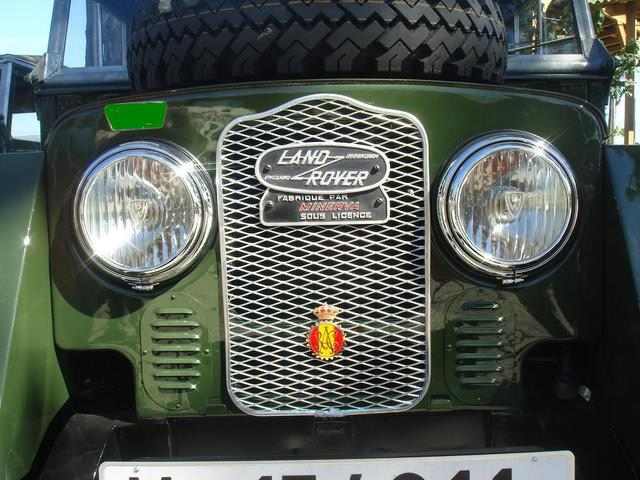
- A narrower front grille carrying Minerva badging
- Larger headlamps, with the side lights moved down to the base of the wings
The giveaway that settles any argument sits in the middle of that narrow grille: a pressed plate reading “Land Rover — fabriqué par Minerva sous licence”, with the crowned Minerva badge below it. It is the whole arrangement in one casting — a British design, acknowledged as such, built under licence by a Belgian firm for a Belgian army — and it is the detail restorers hunt hardest for, because a Minerva re-fitted with a plain Land Rover grille loses the one component that names it.
Contracts and numbers
The Belgian army’s original order for 2,500 vehicles was followed by a second for 3,421. Despatches for 1952 and 1953 alone totalled 7,859 CKD kits. An 86-inch version arrived in 1954, but only 200 of those kits left Solihull that year, and around 1,100 86-inch vehicles were built in total. Relations between the two companies deteriorated from September 1954, and the contracts were terminated at the end of June 1956.
| Figure | Detail |
|---|---|
| First Belgian army order | 2,500 vehicles |
| Follow-on order | 3,421 vehicles |
| CKD kits despatched 1952–53 | 7,859 |
| 86-inch vehicles built | c. 1,100 |
| Total CKD kits, May 1952 – June 1956 | 8,959 |
In Belgian service
The military took just under 8,500 of the vehicles, with the balance sold through the dealer network; a civilian version had been announced in October 1953. Army variants included radio trucks, field ambulances and an armoured version with machine-gun mounts, and from 1980 some vehicles carried the Milan anti-tank missile. The type served for a remarkably long time. When the Volkswagen Iltis began replacing it in 1985, 2,492 Minervas were still on Belgian army strength, more than three decades after the first kits crossed the Channel.
After the contract
Minerva announced its own C-20 and M-20 “Tout Terrain” vehicles in 1956, but few were built and the company went into liquidation in 1958. Survivors of the Land Rover programme turn up regularly on the European collector market, and the rarer military bodies attract serious money: Bonhams has offered both a 1952 Minerva ambulance and an armoured parachute-reconnaissance vehicle in recent years. The Belgian venture also proved that the licence model worked, and Rover repeated the trick elsewhere; Santana in Spain went on to build Land Rovers under licence on a far larger scale, and for far longer.
Frequently asked questions
What is a Minerva TT?
A licence-built Land Rover assembled by Minerva at Mortsel near Antwerp from 1952 to 1956, essentially an 80-inch Series I in left-hand drive with Belgian-made steel bodywork, built first for the Belgian army.
How do you tell a Minerva from a Series I?
Squared, sloping front wings instead of Solihull’s rounded ones, heavier-gauge all-steel bodywork, larger headlamps with the side lights at the base of the wings, and a narrower grille carrying Minerva badging.
How many Minerva Land Rovers were built?
Solihull despatched 8,959 CKD kits between May 1952 and June 1956; the Belgian military took just under 8,500 vehicles, with the balance sold through the dealer network.
How long did the Minerva serve?
Over three decades. When the Volkswagen Iltis began replacing it in 1985, 2,492 Minervas were still on Belgian army strength.