Santana Land Rover: The Story of the Spanish-Built Models from Linares
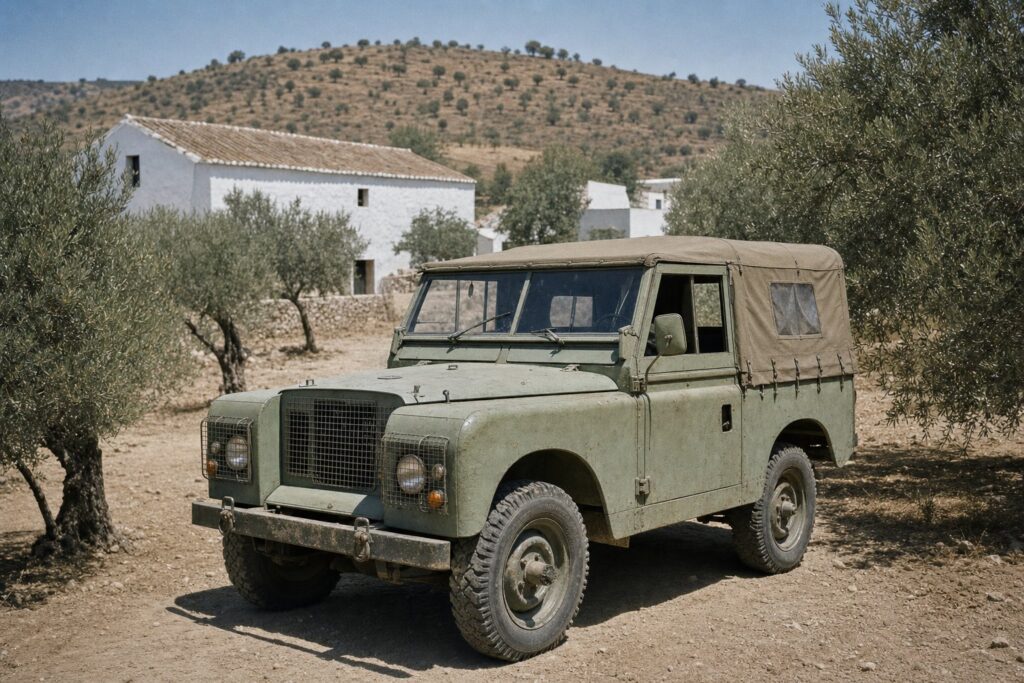
- Years
- 1958–1994
- Engine
- 2.25/2.5 four; 3.4-litre six; 2.25 turbodiesel (1983)
- Drive
- Selectable 4x4
- Origin
- Linares, Jaén, Spain
Ask a British enthusiast to name every factory that built the leaf-sprung Land Rover and the list usually stops at Solihull. It shouldn’t. The Land Rover Santana story runs for over three decades in the Andalusian town of Linares, where a Spanish firm assembled, then re-engineered, and finally out-developed the vehicle it had licensed. A Santana Land Rover is not a replica and not a badge job. It is a parallel bloodline, and in several respects the Spanish models got there before Solihull did: front disc brakes, a factory turbodiesel, a six-cylinder diesel option the British range never offered.
This profile sets out where the Spanish Land Rover came from, how far the two lines diverged, which models matter, and what running one in Britain involves today. Production figures, where sources disagree, are flagged rather than smoothed over.
The Linares story: Metalúrgica de Santa Ana and the 1956 licence
Metalúrgica de Santa Ana, S.A. was formed in Linares, in the province of Jaén, on 24 February 1955. The factory was built with public money, part of a Spanish government drive to industrialise one of the poorest corners of Andalusia, and its first products were agricultural machines rather than motor vehicles.
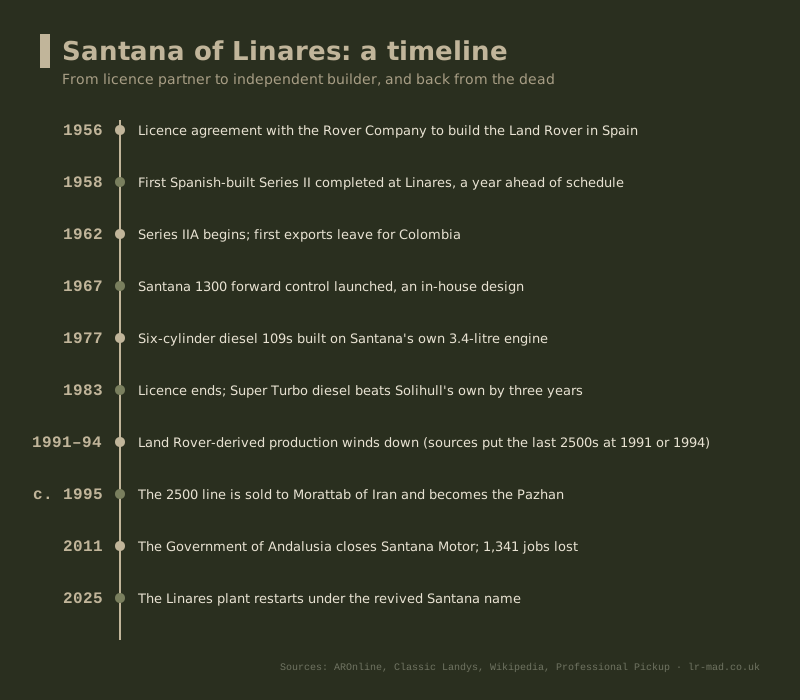
The following year the company reached an agreement with the Rover Company to build the Land Rover under licence. The economics behind the deal were simple. Franco-era Spain protected its home market heavily, so a British-built 4x4 faced tariffs that made it uncompetitive; a Spanish-assembled one did not. Rover shipped completely knocked down (CKD) kits from Solihull, and Santana bolted them together in Linares. The first Spanish-built Series II models appeared in 1958, a year ahead of the scheduled 1959 launch, and Spain had its own Land Rover.
Crucially, the arrangement required the Spanish content of each vehicle to rise steeply over time. That single clause shaped everything that followed, because it forced Santana to learn how to make the vehicle rather than merely assemble it. Within a few years the Linares works was producing engines, gearboxes, axles and body panels on its own tooling.
Exports began in 1962, the same year Series IIA production started, with the first shipment going to Colombia. Morocco, Iran and Costa Rica became the other major destinations. The traffic suited Rover as well as Santana: Spanish-built vehicles could enter Latin American and North African markets on terms the British factory could not match. Santana was not the first overseas licence Rover signed, nor the last. Belgium’s Minerva had built Land Rovers under a 1952 agreement, and Turkey’s Otokar would follow in 1987. The broader arc is covered in the site’s Land Rover history timeline. None of the other licensees, though, travelled anything like as far from the parent as Santana did.
Reuse this timeline with attribution:
<a href="https://www.lr-mad.co.uk/vehicles/santana/"><img src="https://www.lr-mad.co.uk/wp-content/uploads/infographics/santana-of-linares-timeline.svg" alt="Santana of Linares timeline" width="800"></a>From CKD assembly to independence: how Santana diverged from Solihull
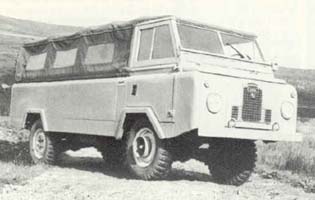
Through the 1960s the Linares product tracked the British one closely, and early Spanish vehicles are near-identical to their Solihull twins apart from badging and trim details. The divergence started with vehicles Solihull never built. In 1967 Santana launched the 1300, a forward-control light truck of its own design, and in 1968 came the 109 “Rural Taxi”, a five-door station wagon with a second row of forward-facing seats. Spain got a five-door Land Rover long before Britain did.
Engines Solihull never offered
The engine bay tells the sharpest version of the story. Santana never adopted the Rover V8. Instead, its engineers stretched the familiar 2.25-litre four into a 3,429 cc six-cylinder, producing roughly 104 hp in petrol form and 94 hp as a diesel. The first six-cylinder diesel 109s left the line in 1977, giving Spanish buyers a torquey oil-burning six that the British Series range simply did not have.
Then came the turbocharger. From 1983 Santana offered the Super Turbo, a turbocharged 2.25-litre diesel rated at around 75 bhp. Solihull’s own Diesel Turbo did not reach customers until 1986. On forced-induction diesels, the licensee beat the licensor by three years.
Chassis, brakes and the parting of ways
Santana fitted front disc brakes to its heavy-duty models well before the equivalent British Series trucks gave up drums, and when Solihull switched the One Ten to coil springs in 1983, Linares went its own way: the new Santana 2500 (Series IV) range kept leaf springs but adopted parabolic ones, a cheaper solution that still transformed the ride. By then the corporate ties were already loosening. The company had renamed itself Land Rover Santana, S.A. in 1981, signed a deal in 1982 that gave Suzuki a 20 per cent stake and a Spanish production line for the SJ-series, and saw its licence arrangement with Land Rover end in 1983. The Land Rover name came off the vehicles, and from that point Linares product was pure Santana.
Parts interchangeability follows the same curve. On a late-1950s or 1960s vehicle, most components are common Solihull-pattern items. From the mid-1970s the overlap shrinks year by year: Santana cast its own engines, cut its own gearboxes, revised bulkheads, dashboards and panels, and by the 2500 era whole assemblies have no British equivalent at all. Consumables such as brake and clutch parts often still cross over. Doors, dashes and drivetrain internals frequently do not, and there is no tidy rule for which is which; it changed model by model and year by year.
The Santana models, from licence-built Series to the PS-10
The range breaks into three broad generations: the licence-built Series vehicles, the increasingly independent Spanish developments of the 1970s and 1980s, and the post-Land Rover products that carried the format into the 2000s.
| Model | Years | What it was |
|---|---|---|
| Series II / IIA | 1958–1974 | Licence-built Solihull design, 88″ and 109″, 2.25 petrol or 2.0/2.25 diesel; Spanish content rising throughout |
| 1300 Forward Control | 1967–1978 | Santana’s own forward-control truck, named for its 1,300 kg payload |
| 109 Rural Taxi | from 1968 | Five-door station wagon with forward-facing second row, a body Solihull never offered on the Series chassis |
| Militar / Ligero | from 1969 | Military family developed in Linares, including deep-fording and desert variants |
| Series III / IIIA | 1974–1983 | Spanish Series III with all-synchromesh gearbox; IIIA brought Santana-specific updates |
| 2000 Forward Control | from 1978 | Replaced the 1300; two-tonne payload, six-cylinder engines as standard |
| Cazorla | from 1982 | Six-cylinder 3.4-litre 109 line, renamed after the Sierra de Cazorla |
| Super / Super Turbo | from 1983 | Four-cylinder line with 2.25/2.5 diesels; Super Turbo was the turbodiesel pioneer |
| 2500 (Series IV) | 1983/84–1990s | Parabolic-sprung final evolution of the leaf-sprung line, civilian and military |
| PS-10 Aníbal | 2002–2011 | Post-Land Rover utility 4x4, Iveco 2.8-litre turbodiesel, launched at the 2002 Madrid Motor Show |
| Iveco Massif | 2007–2011 | Restyled PS-10 sold through Iveco, 3.0-litre diesel in 150 and 176 bhp forms |
Exactly when the Land Rover-derived line ended is one of the places where respected sources part company. One well-researched British account states that Land Rover production was discontinued at the end of 1991, when Suzuki became the largest shareholder and the firm was renamed Santana Motor, S.A. Spanish specialist sources and the standard reference works put the last 2500-family vehicles at 1994. Both versions agree on the direction: by the early 1990s the Suzuki lines were paying the bills, and the old leaf-sprung Santana was living on borrowed time, kept alive largely by military orders.
The PS-10 Aníbal deserves a paragraph of its own, because it brought the story full circle. Launched in 2002 after the company had posted sales of 33,821 units in 2000 falling to 22,736 in 2001, it was a barely disguised Land Rover in layout: separate chassis, leaf-influenced solid-axle suspension, flat panels, and an Iveco 2.8-litre turbodiesel. Unusually, a front-wheel-drive-only version was catalogued alongside the 4x4. Its restyled successor, the Iveco Massif, wore Giorgetto Giugiaro’s updates and an Iveco badge from 2007 but remained a Linares product underneath until production stopped in 2011.
Military Santanas in Spanish service and export users
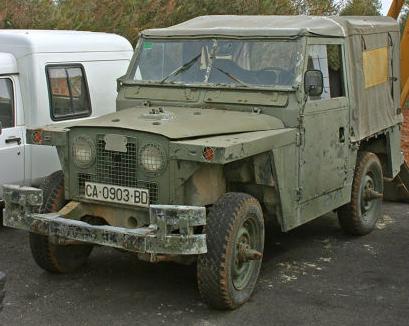
Military work ran through the company’s whole life. Assembly of dedicated military versions began in 1969, developed in Linares rather than copied from Solihull, and the family included ambulances plus special models built for deep fording and desert use. The light 88-inch military vehicle is usually called the Ligero, the Spanish word for “light”; it resembles the British Lightweight at a glance but is a separate development, which is why the two make an instructive side-by-side study for anyone interested in military Land Rovers.
The home customers were the obvious ones. Spanish sources record the armed forces, the Guardia Civil, the Policía Armada and public-works ministries taking Series-based Santanas in volume, with the six-cylinder Cazorla a common sight in army colours, typically in soft-top form with jerrycan mounts on the front bumper. Military demand was persistent enough that it kept the leaf-sprung line in production after civilian interest had moved on, and the Aníbal’s core market after 2002 was again military and utility fleets.
Abroad, the reach was longer than most British accounts acknowledge. Beyond the civilian exports to Latin America and North Africa, Santana licensed its own product onward: Iran’s Morattab group assembled Santana-pattern 88 and 109 models from CKD kits from around 1970, then bought the 2500 production line outright in the mid-1990s and evolved it into the Pazhan. That makes Morattab a licensee of a licensee, a second-generation branch of the Solihull family tree. Readers who enjoy that pattern of local engineering overtaking the parent design will find the same shape in Australia’s Perentie programme, where local content and local requirements produced a vehicle Solihull never quite offered either.
Santana Land Rovers vs British Land Rovers: what’s actually different
The honest answer to “how different is a Santana Land Rover?” is: it depends entirely on the year. The table below summarises the practical differences at their widest, in the late Series III/IIIA and 2500 era.
| Area | British Series / early coiler | Santana equivalent |
|---|---|---|
| Springs | Semi-elliptic leaves; coils from 1983 (One Ten) | Leaf throughout; parabolic leaves from the 2500 of 1983 |
| Big engine | 2.6 six, then 3.5 V8 | 3.4-litre six, petrol and diesel; no V8 ever fitted |
| Turbodiesel | From 1986 (Diesel Turbo) | From 1983 (Super Turbo, ~75 bhp) |
| Front brakes | Drums to the end of Series production | Discs adopted earlier on heavy-duty models |
| Gearbox | Solihull units; all-synchro from Series III | Santana-made units, increasingly to local design |
| Body detail | Solihull panels, dash and bulkhead | Progressively different dashboards, bulkhead vents and panel pressings |
| Badging | Land Rover ovals | Land Rover Santana script to 1983, Santana-only after |
Two practical warnings follow from that table. First, parts. Anyone assuming a Santana is a Spanish-flavoured parts-bin Series truck will hit trouble the first time a gearbox internal, a dash component or a IIIA-specific panel fails, because some items were unique to Linares and can be genuinely hard to source new. Second, identity. Because early vehicles are so similar to British ones, mislabelled examples circulate in both directions; the chassis number, the data plates and details such as bulkhead ventilation and badging locate a truck honestly, and a Spanish first registration is the usual giveaway.
It cuts the other way too. For some owners the Santana-specific features are the attraction: a six-cylinder diesel Series-shaped truck exists nowhere else, the parabolic-sprung 2500 rides noticeably better than a standard leaf Series III, and the earlier factory turbodiesel is a genuine piece of one-upmanship over Solihull.
Ownership today: reliability, parts and values
Mechanically, the received wisdom on the Spanish Land Rover matches the British original, with local flavour. The four-cylinder engines are simple, understressed and rebuildable; the 3.4 six is stout but thirstier, and some of its unique internals take patience to find. Bodywork is the usual Series-family mix of aluminium panels over a steel frame, so bulkheads, door frames and chassis outriggers are the places to poke. Vehicles that spent their lives in inland Spain often carry dry, unwelded chassis of a kind rarely seen on UK-market survivors, which is a strong argument for buying a Spanish-sourced example even with the paperwork that entails.
The Land Rover Santana market has its own geography. Spain remains the obvious hunting ground, and the Canary Islands are a recognised pocket of survivors thanks to the dry climate and decades of agricultural use. In Britain the picture is thinner: a classic Land Rover Santana for sale on UK plates is an uncommon listing, and most examples offered here are recent imports, left-hand drive, priced below an equivalent Solihull-built Series truck of the same age and condition. That discount reflects left-hand drive and badge snobbery more than any engineering deficit, which is precisely why the type appeals to buyers who want a usable leaf-sprung 4x4 rather than a concours queen. Rare variants sit outside that logic; a genuine Ligero, a 2500 turbodiesel or a forward control trades on scarcity.
Importing one is routine rather than difficult: EU-sourced classics need customs clearance and a NOVA notification, then DVLA registration, and vehicles over 40 years old typically qualify for MOT and vehicle-tax exemption. Specialist parts suppliers exist in Spain, several general Series suppliers cover the shared consumables, and owners’ forums have become good at mapping which Santana part numbers cross-reference to British ones.
Whether that makes the Spanish truck a shrewd buy is an editorial judgement, and this site’s view is a qualified yes: prices for honest examples have firmed as the wider Series and Defender market has climbed, the engineering story gives the type a collectability hook the mainstream is only starting to notice, and the 2025 revival of the Santana name has put Linares back in the motoring press. Buy on condition and identity, not on the badge.
Frequently asked questions
What is the main difference between a Land Rover and a Santana Land Rover?
Early Santanas are licence-built Land Rovers and differ only in assembly location and badging. From the mid-1970s the Spanish line diverged: its own six-cylinder engines, earlier front disc brakes, a 1983 turbodiesel, parabolic springs on the 2500, and increasingly Santana-specific gearboxes, dashboards and panels.
Are Santana Land Rovers still being made today?
No. The Land Rover-derived line ended in the early 1990s and Santana Motor itself was closed by its owner, the Government of Andalusia, on 16 February 2011. The Santana name returned in 2025 under new Chinese-backed owners building a modern pickup in Linares, but it has no engineering link to the classic vehicles.
Can I use standard Land Rover parts on a Santana model?
Often, but never assume. Consumables such as brake, clutch and service items frequently interchange, and early vehicles share most components with Solihull ones. Later Santanas used unique engines, gearboxes, bulkheads and panels, and the overlap changed year by year, so parts need checking item by item.
Why did Santana start building Land Rovers in Spain?
Protectionist trade policy. Imported vehicles faced heavy barriers in 1950s Spain, so local assembly was the only realistic route into the market. Metalúrgica de Santa Ana, founded in 1955 with state backing to industrialise Jaén province, secured the Rover licence in 1956 and built its first Series II in 1958.
What should I look for when buying a used Santana Land Rover?
The same structural points as any Series truck: chassis outriggers, bulkhead, door frames and spring hangers. Add Santana-specific checks, which are identity (chassis number and data plates), completeness of unique parts such as the dash and six-cylinder engine ancillaries, and import paperwork if the vehicle is freshly arrived from Spain.
Are Santana Land Rovers a good classic investment in the UK?
They trade below equivalent British-built Series vehicles, largely because of left-hand drive, which gives them room to appreciate as the story becomes better known. Rare variants such as the Ligero, the turbodiesels and the forward controls carry the strongest collector interest. Condition and originality still matter more than the badge.
How can I identify a genuine Santana version of a classic Land Rover?
Start with the chassis number and data plates, which follow Santana’s own sequences rather than Solihull’s. Supporting evidence includes Spanish first registration, Santana badging, bulkhead ventilation and dashboard differences on later vehicles, and model names such as Super or Cazorla that never appeared on British trucks.
What is the process for importing a Santana Land Rover to the UK?
Buy and export from Spain, complete UK customs clearance and a NOVA notification, then register the vehicle with the DVLA. Most classic Santanas are over 40 years old, so they usually qualify for age-related registration plus MOT and vehicle-tax exemption, though insurers will want a proper valuation.
Did Santana build a turbodiesel before Land Rover did?
Yes. The Santana Super Turbo, a turbocharged version of the 2.25-litre diesel producing around 75 bhp, went on sale in 1983. Solihull’s equivalent, the Ninety/One Ten Diesel Turbo, did not arrive until 1986, three years later.
What engines did Santana Land Rovers use?
The familiar 2.25-litre four in petrol and diesel forms, later enlarged to 2.5 litres, plus Santana’s own 3,429 cc six-cylinder created by adding two cylinders to the four, rated at roughly 104 hp in petrol and 94 hp in diesel tune. The V8 was never fitted; the post-Land Rover PS-10 used an Iveco 2.8 turbodiesel.
What was the Santana Ligero?
The light 88-inch member of the military family Santana developed in Linares from 1969. It resembles the British Lightweight but is an independent Spanish design, built for the domestic armed forces alongside 109-inch military models, ambulances and deep-fording variants.
What is the Santana PS-10 Aníbal?
The utility 4x4 Santana launched at the 2002 Madrid Motor Show, long after the Land Rover licence had ended. It kept the classic format of separate chassis and flat panels, used an Iveco 2.8-litre turbodiesel, and was even catalogued in a front-wheel-drive-only version aimed at fleet buyers.
How is the Iveco Massif related to Santana?
The Massif, sold from 2007 to 2011, is a restyled Santana PS-10 built in Linares and marketed through Iveco, with styling input from Giorgetto Giugiaro and a 3.0-litre diesel in 150 or 176 bhp form. Poor sales ended production in 2011, the year the company closed.
Did Santana vehicles serve with the Spanish military?
Extensively. Dedicated military versions were assembled from 1969, and Spanish sources record the armed forces, Guardia Civil and Policía Armada running Series-based Santanas in volume, with the six-cylinder Cazorla a staple in army service. Military orders kept the leaf-sprung line alive into the 1990s.
What happened to Santana’s tooling after Land Rover production ended?
A large part of it went to Iran. Morattab, which had assembled Santana-pattern vehicles from CKD kits since around 1970, bought the 2500 production line in the mid-1990s and developed it into the Pazhan, keeping the leaf-sprung Santana design in production long after Linares had moved on.
Why did Santana Motor close in 2011?
Sales collapsed and no partner remained. Iveco ended the Massif arrangement in 2010, output fell from 6,692 vehicles in 2007 to 769 in 2010, and the Government of Andalusia, which owned the firm, shut it on 16 February 2011 with the loss of 1,341 jobs.
In summary
The Santana Land Rover began as a tariff workaround and ended as one of the most interesting branches of the whole Land Rover family: Spanish models that started as Solihull kits, then grew their own engines, their own military range, their own forward controls and their own successor vehicle. For British owners the type offers Series character with several upgrades Solihull took years to match, at prices that still undercut the home-grown equivalent. The catch is homework: identity, year-specific parts and import paperwork all reward care. Where the Spanish trucks sit alongside the other licence-built and military branches of the family is mapped in the full vehicle registry.