Land Rover Perentie specifications and history
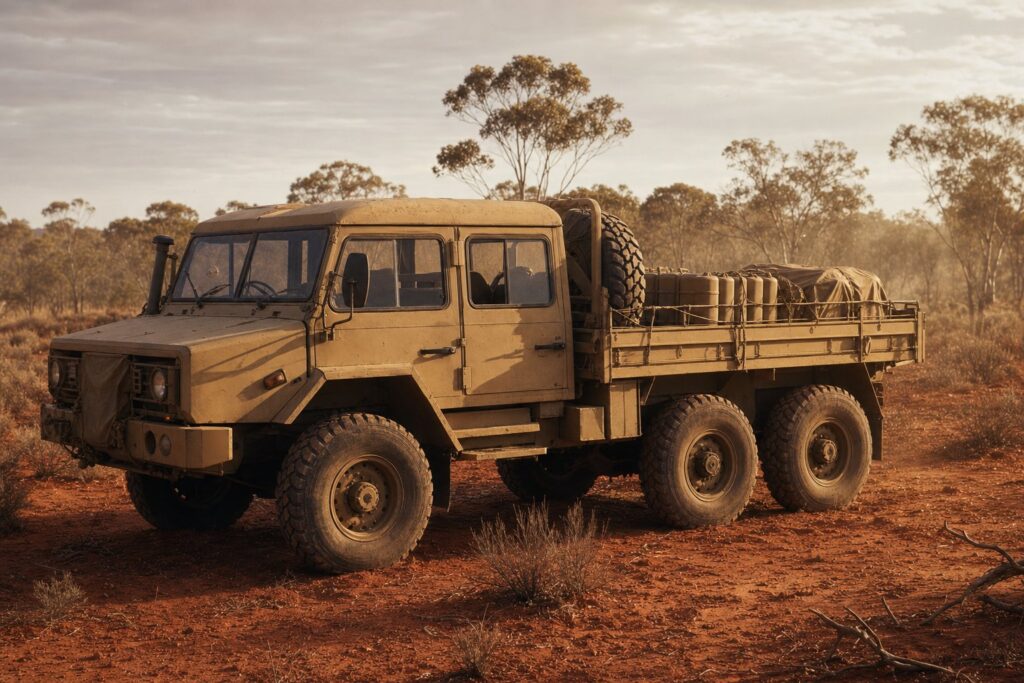
- Years
- 1987-1992 (follow-on 1996-1998)
- Engine
- Isuzu 4BD1 3.9-litre diesel (4BD1-T turbo, 6x6)
- Drive
- 4x4 / 6x6
- Built
- 4,079 (3,048 4x4 + 720 6x6 + 311 follow-on)
- Origin
- Moorebank, NSW, Australia
The Land Rover Perentie is the 110 that Australia declined to take as offered. Between 1987 and 1992, Jaguar Rover Australia (JRA) built roughly 3,770 of them at Moorebank in Sydney’s south-west for the Australian Army: re-engined with an Isuzu truck diesel, carried on a hot-dip galvanised chassis, and stretched into the Perentie 6x6 and its offshoots, configurations Solihull never catalogued. A further 311 followed from a second plant in Adelaide in the late 1990s. The Perentie served in Somalia, Timor-Leste, the Solomon Islands, Iraq and Afghanistan, and needed five different replacement vehicles from three manufacturers when the Army finally retired it.
This profile covers the tender and trials, the changes against the British 110, every variant with verified build numbers, the Long Range Patrol Vehicle of the Special Air Service Regiment, and buying one in the UK today. It sits within the military Land Rovers reference alongside the rest of the vehicle registry.
Why Australia built its own Land Rover
Land Rover had supplied the Australian Army since 1959: some 1,841 Series II, 4,776 Series IIA and 2,303 Series III vehicles by 1981, most of them 109-inch models assembled in Sydney. They were close cousins of the civilian product, and by the late 1970s that had become the problem. The Army was moving to an all-diesel fleet, and the British 2.3-litre diesel produced a feeble 45.6 kW; a 1981 Army report damned it with “modest performance but with good economy” at a time when Nissan sold a 60 kW diesel Patrol and Toyota a 77 kW Land Cruiser.
In February 1981 the Department of Defence released an Army Staff Requirement for new lightweight (one-tonne) and light (two-tonne) trucks; the detailed requirements went to industry in June 1982 as Project Perentie, named after Australia’s largest monitor lizard for its speed and endurance over rough country. Two conditions shaped everything that followed: assembly in Australia with maximum local content, and development from models already available on the civilian market rather than one-off military prototypes.
The trials: Land Rover against Mercedes and Jeep
Seven tenders arrived in each weight class. The one-tonne shortlist was the Land Rover 110 4x4, a militarised Jeep and the Mercedes-Benz 300GD; in the two-tonne class only Land Rover’s proposed 110 6x6 and the Mercedes-Benz Unimog U1300 made the cut. Three examples of each went to the Army in September 1983.
The testing regime ran accelerated durability trials at Monegeetta, hot-dry work at Woomera, hot-wet at Tully and cold-weather trials at Khancoban, spread over about a year. Land Rover won both categories. The initial order, under a contract awarded to JRA in October 1986, came to 2,500 4x4 and 400 6x6 vehicles, with initial production vehicles from 1986 and full production from May 1987. That order grew substantially, as the tables below show.
The stakes were absolute: local Land Rover assembly had dwindled to about two vehicles a day, and JRA’s engineering manager, Ray Habgood, later admitted that without the Perentie win the Moorebank operation would have closed altogether.
Design against the UK 110
The Perentie kept the general shape of the coil-sprung 110 and diverged almost everywhere underneath.
The Isuzu 4BD1 diesel
Habgood’s team surveyed the diesel engines then available and settled on the Isuzu 4BD1, a 3.9-litre direct-injection four-cylinder built for light trucks. It matched the Rover 3.5-litre V8 closely enough in size and output to drop in with little modification; it was proven, understressed in something as light as a Land Rover, and frugal; and a turbocharged version was coming. Isuzu assembled special 4BD1 engines for the application, with a noise-reduction package of double-skinned rocker cover, rubber-mounted sump and modified pistons.
The 4x4 Perentie used the naturally aspirated 4BD1, generally quoted at around 70 kW (about 95 bhp), driving through the heavy-duty LT95A four-speed gearbox with integral transfer case. The 6x6 took the turbocharged 4BD1-T at 90 kW, fitted so the heavier vehicle could stay honest against the Unimog in the trials. Neither engine made the Perentie quick. Both made it nearly unburstable, which was the point.
Galvanised chassis and military detailing
Every Perentie rode on a hot-dip galvanised chassis, the single most obvious advantage the type holds over British-built 110s and Defenders to this day. On the 4x4 the frame was modified at the rear to sling the spare wheel underneath, keeping the load bed clear. The requirement went beyond rust-proofing: the structure had to survive being lifted by one corner from a helicopter without distorting, and all Perenties carry lifting hooks with the centre of gravity marked on both sides.
The details reward a close look. The exhaust runs in line with the wheels and exits behind the rear tyre, so flattened grass never touches hot pipework, a fire precaution for the outback. Convoy lighting includes a lamp under the chassis shining onto the rear differential’s white-painted back plate, visible to the vehicle behind but not from the air. A stout rear bar carries four jerry cans, storage bins sit in the body sides, and everything wore durable polyurethane paint. Local content was a contract condition; figures quoted for the programme put more than 70 per cent of the vehicle’s value as Australian-made.
The 4x4 fleet and variants
Deliveries of the 4x4 began in August 1987, and ten variants were built during the JRA run. The figures below derive from ex-military registry records compiled by REMLR and published marque histories.
| Perentie 4x4 variant (1986–1992) | Built |
|---|---|
| Cargo soft-top | 1,222 |
| Cargo soft-top with winch | 316 |
| Fitted For Radio (FFR) soft-top | 984 |
| FFR soft-top with winch | 169 |
| Regional Force Surveillance Vehicle (RFSV) | 243 |
| RFSV with FFR equipment added | 20 |
| Survey hard-top | 39 |
| Command Post hard-top | 2 |
| Senior Commander station wagon | 11 |
| Personnel Carrier station wagon | 42 |
| Total 4x4, JRA production | 3,048 |
Published totals for the 4x4 disagree, and it is worth being precise about why. The initial 1986 order specified 2,500, and that figure still circulates as if it were the final count; older enthusiast sources quote 3,005 in regular service. The registry-derived table puts JRA-era output at 3,048 by September 1992, plus another 61 4x4s under the 1996–98 follow-on contract. Around 3,100 in total is the defensible figure.
The most storied 4x4 is the Regional Force Surveillance Vehicle. The 243 RFSVs went to the units watching Australia’s north (Norforce, the Pilbara Regiment and the 51st Far North Queensland Regiment) carrying twin spare wheels, double jerry-can holders, roll-over protection and, originally, roof racks for a boat. Many went through a mid-2000s overhaul by defence contractor Tenix, gaining revised roll-over structures and gun-ring options.
The 6x6 family and the Long Range Patrol Vehicle
Accounts of where the 6x6 idea came from do not entirely agree. A version repeated for years in enthusiast circles credits SMC Engineering of Bristol with the original design, following an enquiry from the Australian Department of Defence routed to Tom Barton at Land Rover. Habgood’s first-hand account describes a local engineering decision: his team examined reviving the 101, using the Spanish-built Santana forward control, or adopting one of the third-party British 6x6 conversions of the kind pioneered by Scottorn, then chose to develop their own. A Hotspur-built Sandringham 6x6 imported for evaluation showed too much body roll on its coil-sprung rear, so the team designed around load-sharing leaf springs instead; the engineering that reached production was demonstrably Australian.
The production Perentie 6x6 was close to a new vehicle. The chassis was fabricated from galvanised rectangular steel tube with a deep central well between the rails that later proved decisive. The rear bogie used two Salisbury axles with a pivoting cross-over spring hanger sharing load between them. Drive came from the LT95 gearbox first used in the 101 Forward Control, whose power take-off output conveniently provided a third propshaft drive. The cab was a galvanised steel space frame widened by 200 mm to seat three abreast, retaining Land Rover doors and wings beneath a fibreglass bonnet and flat windscreen. All 6x6s had disc brakes on every axle and Adwest power steering.
Instead of dropping box shelters onto a flat tray, Habgood used that chassis well to mount removable fibreglass modules, built by Jakab Industries of Tamworth, directly to the frame. A soldier could stand upright inside, yet the complete vehicle still rolled into a C-130 Hercules without dismantling. One common chassis thus carried ambulance, workshop, electronic repair, air defence and satellite-communications bodies; the field ambulance earned a write-up in the Royal Australian Army Medical Corps journal calling it “perhaps the best field ambulance in the world”.
| Perentie 6x6 variant (1986–1992) | Built |
|---|---|
| Cargo (incl. 1 left-hand drive) | 232 |
| Cargo with winch | 57 |
| Cargo FFR with winch (RAAF) | 7 |
| Air Defence tractor, Rapier | 51 |
| Air Defence tractor, RBS70 | 17 |
| Ambulance FFR with winch | 76 |
| General Maintenance Vehicle | 162 |
| Electronic Repair Vehicle | 51 |
| Crew Cab (Parakeet) | 26 |
| Long Range Patrol Vehicle | 27 |
| Exports (Oman 11, Malawi 2, Singapore 1) | 14 |
| Total 6x6, JRA production | 720 |
Period references that put the Perentie 6x6 fleet at around 700 vehicles check out well: 720 left Moorebank, and a further 250 six-wheelers arrived under the follow-on contract, 148 of them Interim Infantry Mobility Vehicles.
The SAS and the Long Range Patrol Vehicle
The Special Air Service Regiment had run Series IIA-based patrol vehicles since the 1960s, and after watching the 6x6 trials it asked JRA for a mock-up built to its own specification. The result became the Long Range Patrol Vehicle: a semi-open 6x6 with a crew of three (two in a doorless cab, one facing rearwards), a large fuel tank under the floor and spare wheels stowed in the body sides.
Loaded with crew, stores and equipment the LRPV weighs 4,840 kg; its tanks hold 365 litres of diesel, enough for around 1,600 km in desert conditions at a maximum speed of about 95 km/h. Armament typically comprised a MAG 58 machine gun at the front passenger position and an M2 Browning or Mk 19 grenade launcher on a rear ring mount, with a MINIMI often carried as well. A 250 cc Suzuki motorcycle rode on a tailgate mount for dismounted reconnaissance.
Twenty-seven were built, a figure best read carefully: 26 operational vehicles entered service from 1991, alongside a development prototype later dismantled and a single left-hand-drive V8 petrol demonstrator built for export shows, now at the Bandiana Army Museum. The fleet worked hard, deploying to Kuwait in 1998, Afghanistan from late 2001 and Iraq in 2003. Australia’s first casualty of the Afghanistan campaign, Sergeant Andrew Russell, died when his LRPV struck a mine in February 2002; the damaged vehicle is preserved, unrestored, at the Australian War Memorial. Under the follow-on programme the related Surveillance Reconnaissance Vehicle, with its door-mounted spare wheels, equipped the Commando Regiment.
Land Rover Perentie specifications
The Land Rover Perentie specifications below combine registry records, published marque histories and defence reference sources. Where sources disagree, the range is shown.
| Specification | Perentie 4x4 | Perentie 6x6 / LRPV |
|---|---|---|
| Engine | Isuzu 4BD1, 3.9-litre four-cylinder diesel | Isuzu 4BD1-T, 3.9-litre turbo-diesel |
| Power | c. 70 kW (95 bhp) | 90 kW (121 bhp) |
| Gearbox | LT95A four-speed, integral transfer case | LT95 four-speed with PTO-derived third output |
| Drive | Permanent four-wheel drive | Selectable six-wheel drive |
| Chassis | Hot-dip galvanised, modified 110 frame | Hot-dip galvanised RHS tube, central well |
| Suspension | Coil springs, uprated rear | Coils front, load-sharing leaf-sprung rear bogie |
| Brakes | Disc front, drum rear | Discs all round |
| Payload class | 1 tonne | 2 tonnes |
| Wheelbase | 2,794 mm (110 in) | 3,040 mm to centre axle; 3,940 mm overall |
| Loaded weight | c. 3,200 kg GVM (tray models) | LRPV 4,840 kg with crew and stores |
| Fuel capacity | Main tank plus four jerry cans | Twin underseat tanks; LRPV 365 litres |
| Range | — | LRPV c. 1,600 km in desert conditions |
| Top speed | c. 100 km/h | c. 95 km/h (59 mph) |
| Built | 3,048 (plus 61 follow-on) | 720 (plus 250 follow-on) |
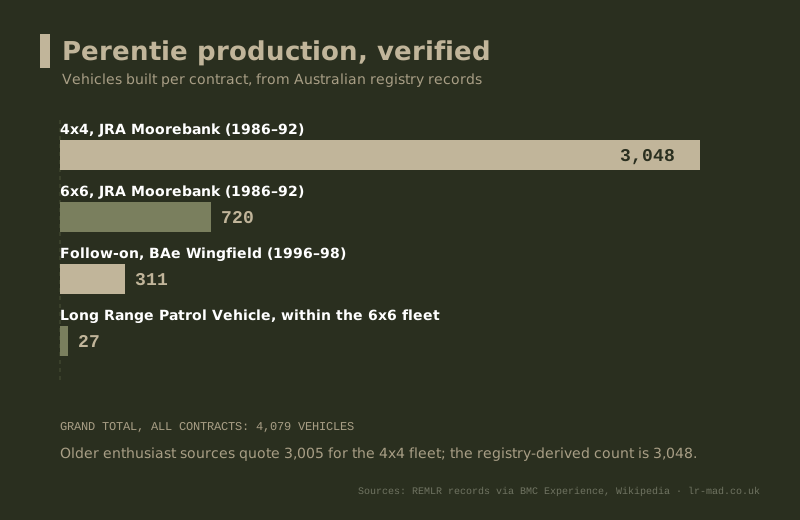
Reuse this chart with attribution:
<a href="https://www.lr-mad.co.uk/vehicles/perentie/"><img src="https://www.lr-mad.co.uk/wp-content/uploads/infographics/perentie-production-verified.svg" alt="Land Rover Perentie production numbers" width="800"></a>Service life, retirement and survivors
JRA hit financial trouble in 1991, squeezed by Australia’s new luxury car tax, and Rover in the UK absorbed its assets. Because the contract demanded local assembly and support, Rover Australia was re-established to finish the job, and Moorebank built its last Perentie before closing on 30 September 1992. The Army later exercised its follow-on option: 311 additional vehicles came from British Aerospace’s plant at Wingfield, South Australia, between 1996 and 1998 under Project Bushranger. Two 4x4s even received TD5 engines at Longbridge in 1998 for trials against a British Army Wolf; both reverted to Isuzu power.
The fleet’s service record stretched far beyond the outback, and Tenix’s mid-2000s overhaul programme kept the surveillance fleet current for another decade. Retirement came under Project Overlander (Land 121). From about 2013 the general-service 4x4s gave way to Mercedes-Benz G-Wagons, specialist 4x4 roles passed to the Thales Hawkei, some six-wheelers were replaced by the Bushmaster, and the SAS received the Supacat-based Nary. It took those five vehicle types, from three manufacturers, to cover what one Land Rover family had done.
Survivors are plentiful in Australia and increasingly visible elsewhere. Disposals ran through Australian Frontline Machinery, the authorised sales channel for Defence, and thousands of 4x4s passed into private hands. Museum pieces include the mine-damaged Long Range Patrol Vehicle at the Australian War Memorial, an early LRPV in the SASR historical collection and the V8 demonstrator at Bandiana. For the wider story of how Land Rover reached this point, see the Land Rover history timeline.
Buying a Perentie today
The Perentie has become one of the most tempting ex-military Land Rover buys of its generation, and for UK enthusiasts it carries a rare advantage: nearly every vehicle is right-hand drive, and every chassis left the factory galvanised, so a thirty-five-year-old example usually shows less frame corrosion than a ten-year-old British Defender.
Supply starts in Australia, where ex-Army examples sold through official disposal auctions from 2013 onwards and now circulate on the classic and 4x4 market, from tidy cargo trucks to fully equipped RFSVs with logbooks recording every bolt the Army ever replaced. A service-history book, where present, is gold. UK buyers face shipping, a NOVA notification to HMRC on arrival, and DVLA registration, typically on an age-related plate. No IVA test applies to vehicles this old; an MOT and correctly aimed headlamps are the practical hurdles, and speedometers read in km/h.
Condition points are consistent across the fleet. Check bulkhead corners and door frames (the aluminium body corrodes even though the chassis does not), brakes on vehicles that have sat in storage, clutch actuation on 6x6s, and the 24-volt electrics on FFR examples. Engine parts are no obstacle: the 4BD1 powered Isuzu N-series trucks worldwide, so filters, gaskets and complete engines remain available through commercial truck suppliers. Values move with variant and condition rather than age. Honest cargo soft-tops sit at the affordable end, RFSVs and winch vehicles command premiums, and the six-wheelers, especially ambulance and workshop bodies popular as camper conversions, occupy a market of their own.
Frequently asked questions
How much does a Land Rover Perentie cost to buy in the UK?
UK prices depend on variant, condition and history rather than a settled market rate. Standard 4x4 cargo models sit at the accessible end of ex-military pricing, while RFSVs and 6x6 conversions command several times as much, and shipping, import processing and registration add to any Australian purchase price.
What is the process for importing a Perentie from Australia to the UK?
The vehicle ships by roll-on/roll-off or container, then the importer submits a NOVA (Notification of Vehicle Arrivals) to HMRC and pays any duty and VAT due. DVLA registration follows on form V55/5 with evidence of age and origin; because all Perenties are well over ten years old, no IVA test is required.
Is a Land Rover Perentie road legal in the UK, and how is it registered with the DVLA?
Yes. Registration follows the normal imported-vehicle route: NOVA first, then a DVLA application with proof of age, which usually secures an age-related plate. An MOT, insurance and correctly aimed headlamps complete the picture; the km/h speedometer is permissible.
What kind of insurance suits a Perentie in the UK?
Specialist classic and military-vehicle insurers handle Perenties far better than mainstream policies, which struggle with an imported ex-army Land Rover on an age-related plate. Agreed-value cover is advisable, and membership of an owners’ club or military vehicle organisation often reduces premiums.
Which Perentie is better for an overland or camper conversion, the 4x4 or the 6x6?
The 6x6 is the natural camper base: a two-tonne payload, a wide three-seat cab, and workshop or ambulance modules that convert into living quarters with standing headroom. The 4x4 makes a lighter, cheaper, more manoeuvrable overlander that is easier to ship and park.
Are parts for the Isuzu 4BD1 engine available in the UK?
Yes, and more easily than for many period Land Rover engines. The 4BD1 served in Isuzu N-series commercial trucks worldwide, so service parts, injection components and complete replacement engines flow through commercial vehicle suppliers.
Does a Perentie meet UK ULEZ and Clean Air Zone requirements?
Not on emissions grounds: a 1980s pre-Euro diesel falls foul of ULEZ and most charging Clean Air Zones, so daily charges apply. The exemption route is the historic vehicle tax class, available once a vehicle is 40 years old, which the earliest 1986–87 Perenties are now reaching.
What are the most common issues when buying a used ex-military Perentie?
The galvanised chassis rarely gives trouble, so attention shifts to the aluminium body: bulkhead corners, door frames and fixings where dissimilar metals meet. Vehicles from long storage need brakes, seals and tyres checked, and FFR models carry 24-volt electrics. A logbook of Army service history is the strongest reassurance a buyer can get.
Are all Land Rover Perenties right-hand drive?
Very nearly. Production records show one left-hand-drive 6x6 cargo vehicle, one LHD V8 demonstrator and eleven logistics vehicles supplied to Oman; every vehicle delivered to the Australian Army was right-hand drive, which suits UK buyers perfectly.
How many Land Rover Perenties were built in total?
Registry-derived figures put JRA production at 3,048 4x4s and 720 6x6s to September 1992, plus 311 follow-on vehicles from BAe Wingfield in 1996–98, giving 4,079 across all contracts. Older figures of 2,500 and 3,005 for the 4x4 reflect the initial order and early fleet counts respectively.
What engine does the Perentie use?
All Perenties use the Isuzu 4BD1, a 3.9-litre direct-injection four-cylinder diesel from Isuzu’s truck range. The 4x4 has the naturally aspirated version of around 70 kW, while the 6x6 carries the turbocharged 4BD1-T producing 90 kW.
What does the name Perentie mean?
The perentie is Australia’s largest monitor lizard. The Army named its vehicle replacement programme after it for the animal’s speed and toughness over rough country, and the name transferred to the winning Land Rover.
How many Long Range Patrol Vehicles were made, and can one be bought?
Twenty-seven, of which 26 were operational vehicles for the Special Air Service Regiment. Examples are preserved at the Australian War Memorial and in the SASR historical collection; genuine LRPVs essentially never reach the open market, so buyers encounter replicas built on 6x6 cargo chassis instead.
What replaced the Perentie in Australian service?
Five vehicles from three manufacturers under Project Overlander: Mercedes-Benz G-Wagons in 4x4 and 6x6 form, the Thales Hawkei for protected specialist roles, the Bushmaster for some six-wheeler tasks, and the Supacat-based Nary for the SAS. Disposals began around 2013.
Did the Perentie see active service overseas?
Extensively. Perenties deployed to Somalia, Timor-Leste and the Solomon Islands, and the Long Range Patrol Vehicles served with the SAS in Kuwait, Afghanistan and Iraq; the mine-damaged LRPV at the Australian War Memorial came home from Afghanistan.
Where can accurate Land Rover Perentie specifications be found?
The Registry of Ex-Military Land Rovers (REMLR) holds the most complete production and specification records, and marque histories drawing on Land Rover Australia’s engineering papers fill in the design detail. Published specifications disagree on some figures, notably 6x6 torque outputs and fleet totals, because early fleet counts and the final production tables were compiled at different times.
In summary
The Land Rover Perentie is the most thoroughly re-engineered vehicle of the utility line ever put into series production, and arguably the best of it. Australia took a 110, gave it an engine that suited the country, a chassis that ignores rust and a 6x6 derivative the parent company never managed, then worked the fleet for a quarter of a century. Verified production came to 3,048 4x4s and 720 6x6s from Moorebank plus 311 follow-on vehicles, among them 27 Long Range Patrol Vehicles whose SAS service gave the type its legend. For the UK enthusiast it offers something rare: an affordable, galvanised, right-hand-drive military Land Rover with a genuine story. Related registry entries on the Scottorn 6x6, the Forward Control family and the licence-built Santana models trace the engineering threads that met here.