Prototype Land Rovers: Centre Steer, Velar and the Centaur
- Years
- 1947–1987
- Drive
- 4x4 and half-track
- Origin
- United Kingdom
Every Land Rover in this registry began as somebody’s experiment, but a handful of vehicles never made it past that stage. The prototypes file covers the machines that shaped what Solihull built without ever being built themselves in numbers: the centre-steer mule of 1947, the disguised 100-inch station wagon that became the Range Rover, and the stranger dead ends — a half-track, a floating forward-control successor — that armies looked at, tested and politely declined.
The centre-steer prototype (1947)
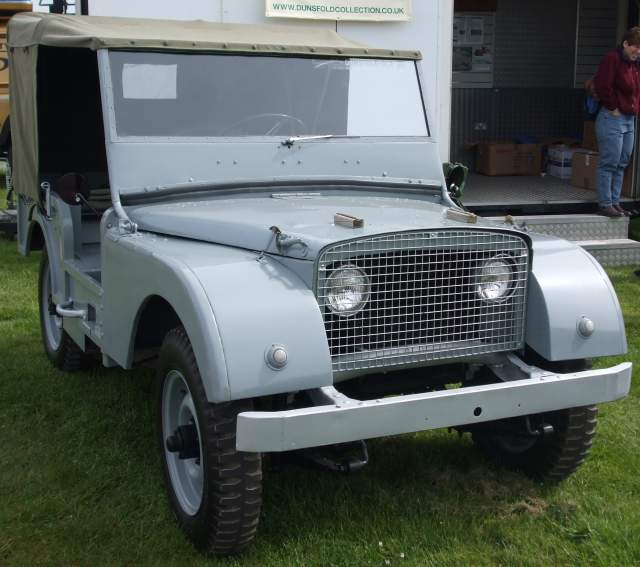
The first Land Rover of all was built in the summer of 1947, after Maurice Wilks sketched the idea of a stopgap agricultural 4x4 for the export drive. The prototype sat on a war-surplus Jeep chassis with a Rover car engine, and carried its steering wheel in the middle of the cab — one layout for every export market, and a tractor-like driving position for field work. The centre-steer arrangement did not survive contact with real drivers: it was dropped before the pre-production run, and no original centre-steer vehicle survives.
The pre-production batch and HUE 166 (1948)
Ahead of the launch at the Amsterdam Motor Show on 30 April 1948, Rover built a batch of 48 pre-production vehicles to prove the design. The first of them, registered HUE 166 and known ever since as “Huey”, still exists and is the founding exhibit of the marque’s own historic collection. Several other pre-production survivors are documented, and their early chassis details — galvanised parts, hand-finished panels — differ noticeably from production Series Is.
Road Rover: the estate that never was (1952–1958)
The Road Rover was the first attempt to put Land Rover practicality into a road car: a two-wheel-drive estate on Rover saloon underpinnings, started in the early 1950s and reworked substantially before the project was shelved by the end of the decade. Nothing reached the public, but the thinking resurfaced a decade later in the vehicle below.
The 100-inch station wagon, alias Velar (1967–1970)
The prototype for what became the Range Rover was completed in 1967 under Spen King’s engineering team, and took its internal name from its 100-inch wheelbase. To keep the project quiet, the pre-production cars were registered under a cover name, Velar, with their own badging — a disguise Land Rover liked enough to resurrect as a model name half a century later. The Velar-badged development fleet ran on public roads until the production Range Rover was announced in June 1970; a number of the cars survive and are actively traded among collectors.
Laird Centaur: the half-track (1978)
The Centaur was the wildest of the military experiments: Laird (Anglesey) Ltd mated the front end of a V8 Land Rover with a shortened tracked running gear derived from the Alvis CVR(T) family, producing a half-track with a Land Rover cab and a tank’s footprint. It was demonstrated to a series of armies in the late 1970s and early 1980s and drew genuine interest, but orders never followed and the number built stayed in single figures. Published accounts disagree on the exact count and on which examples went abroad; the surviving vehicles occasionally appear at military shows. The donor vehicle’s story is in the Stage 1 V8 file.
Llama: the 101’s lost successor (1980s)
When the military 101 Forward Control reached the end of its service life, Land Rover developed a replacement: Project Llama, a forward-control prototype built in the mid-1980s around proven Land Rover running gear. A small batch of prototypes was completed and trialled, but the Ministry of Defence bought conventional trucks instead, and Llama was quietly cancelled — the last forward-control Land Rover ever built. The wider service story is in the military Land Rovers guide.
The prototypes explain the production vehicles: the centre-steer taught Solihull what farmers actually wanted, the 100-inch station wagon created a market segment, and the Centaur and Llama marked the outer edge of what a Land Rover could be stretched into. Where published sources disagree — and for the Centaur they do — the registry says so rather than picking a number.